
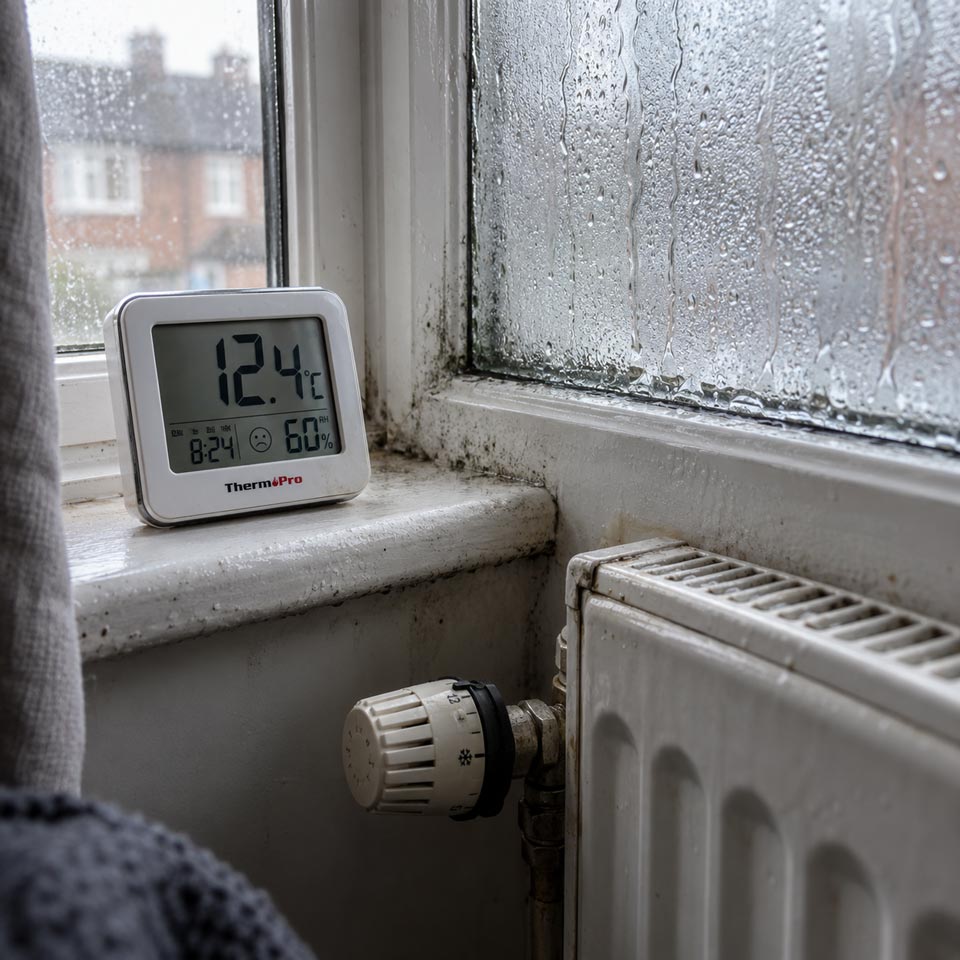
Having no heating in your home can be extremely uncomfortable, particularly during the colder months. If you live in a council property or housing association home and your heating breaks down, your landlord will generally be responsible for arranging the necessary repairs. But what happens if they fail to respond, leave you without heating for days or weeks, or repeatedly carry out repairs that do not resolve the problem?
You may be entitled to claim compensation for broken heating if your social housing landlord has failed to meet its legal repairing obligations. However, a heating breakdown does not automatically mean you have a valid compensation claim. The circumstances, including how quickly you reported the fault, your landlord’s response and the impact on your household, will all be important.
In this guide, we explain when a heating failure might justify compensation, the responsibilities of councils and housing associations, and the steps you should take if your heating is not repaired.
This article explains the legal position as at October 2026. Housing law differs across England, Wales, Scotland and Northern Ireland. The main legal framework discussed below applies to England, with separate guidance for the other UK nations.
What Should You Do If Your Heating Breaks Down?
If your heating stops working, you should report the problem to your council or housing association immediately. This is particularly important during winter, when a lack of heating can quickly make a property unsuitable or potentially unsafe for its occupants.
Most social housing providers operate an emergency repairs service, including an out-of-hours telephone number. You should use this service if you have completely lost your heating, particularly during cold weather or where somebody in your household may be vulnerable to low temperatures.
When reporting the fault, explain whether you have any heating at all, whether your hot water is also affected, and whether children, older people or individuals with health conditions or disabilities live in the property.
After speaking to your landlord, it is sensible to follow up by email or through their online reporting system. This creates a written record of when you first raised the problem and what you were told.
Government guidance recommends reporting disrepair promptly, keeping written records and giving your landlord an appropriate opportunity to carry out repairs. What constitutes a reasonable repair period depends on the circumstances and seriousness of the problem. [1]
Is Your Council or Housing Association Responsible for Repairing Broken Heating?
In most social housing tenancies, the landlord is responsible for maintaining the heating installations supplied with the property. These may include the central heating boiler, radiators, pipework, fixed electric heating and equipment used to provide hot water.
This responsibility usually extends to maintaining the installations in proper working order, rather than simply repairing them when they completely stop functioning.
For example, a heating system might still switch on but fail to warm the property adequately because of defective radiators, insufficient circulation or a recurring fault. Depending on the cause and severity, this could still be a repair issue.
However, the landlord is not necessarily responsible for every heating-related problem. If the problem concerns a portable heater you purchased yourself, an interruption to an independently supplied utility service, or damage caused by tenant misuse, the position may be different.
Tenancy agreements can also contain relevant provisions, although landlords cannot simply avoid statutory repairing obligations through their tenancy terms.
When Can You Claim Compensation for Broken Heating?
A heating failure may become the basis of a housing disrepair compensation claim where your landlord knew, or should reasonably have known, about a problem for which it was responsible and failed to take appropriate action.
The following circumstances may make a claim more likely to be pursuable:
- Unreasonable delays: You reported a heating breakdown, but your landlord failed to arrange appropriate repairs within a reasonable period.
- Repeated breakdowns: The heating system repeatedly stops working and your landlord fails to investigate or resolve an underlying defect.
- Failure to respond to an emergency: Your landlord failed to investigate or make safe a serious heating-related hazard requiring emergency attention.
- Inadequate heating: Defects in a landlord-maintained system leave your home persistently too cold despite previous repair reports.
- Additional losses: The failure to repair caused substantial inconvenience, additional expenses or other losses for which your landlord may be legally responsible.
The strength of a potential claim will depend on the available evidence. It is also important to distinguish between a landlord’s failure to provide an adequate repairs service and a legally actionable breach of its repairing obligations.
Common Scenarios Involving Broken Heating in Social Housing
Not every heating problem is the same. Some situations may justify a legal claim, while others might be resolved through an emergency repair or the landlord’s complaints procedure.
1. Your Boiler Breaks Down During Winter and Nobody Attends
Imagine your boiler stops working on a freezing Friday evening, leaving your household without heating or hot water. You contact your housing association’s emergency repairs service, but no engineer attends and you receive no meaningful response until the following week.
This could be particularly concerning if the property becomes dangerously cold or somebody in your household has medical needs that make prolonged exposure to cold temperatures especially harmful.
Depending on the circumstances, the absence of heating could constitute an emergency hazard. Under Awaab’s Law in England, social landlords must investigate and make safe qualifying emergency hazards within 24 hours of becoming aware of them. [4]
However, this does not mean that every boiler breakdown automatically qualifies under the 24-hour statutory requirement. The seriousness of the hazard and the circumstances of the household must be considered.
2. Your Heating Keeps Breaking Down Despite Previous Repairs
Repeated heating failures can be particularly frustrating. Your landlord might send an engineer each time you report a problem, but the system continues to break down a few days or weeks later.
For example, a council tenant might report six separate boiler failures over one winter. Engineers repeatedly reset the system or replace minor components, but the underlying defect remains unresolved.
Although the landlord has responded to individual reports, the pattern of failures may suggest that it has not taken reasonable steps to provide a lasting solution.
A claim may be worth investigating where the recurring defect, inadequate repairs and resulting loss of heating can be established. Repair histories and previous contractor reports can be particularly useful evidence.
3. Your Heating Works, but Your Home Remains Too Cold
A heating system does not have to stop working completely for a problem to amount to disrepair.
For example, several radiators might remain cold despite the boiler operating, or a defective heating installation might struggle to warm the bedrooms and living room to a reasonable temperature.
If the landlord-maintained installation is defective and your council or housing association fails to address the problem after being notified, there may be grounds for a claim.
Persistent cold can also raise concerns about whether a home is fit for human habitation. However, a poorly insulated or difficult-to-heat property does not automatically establish a breach of the landlord’s repairing obligations. The cause, legal duties and overall condition of the property must be assessed.
4. Your Landlord Provides Temporary Electric Heaters
Some landlords provide portable electric heaters while a boiler or central heating system is being repaired. This can be a sensible temporary measure, particularly where an immediate permanent repair is not possible.
Providing suitable temporary heating may reduce the immediate impact of a breakdown and affect whether compensation is appropriate.
However, temporary heaters do not necessarily remove the landlord’s responsibility to repair the permanent heating installation within an appropriate period.
If the heaters are inadequate, only warm a small part of the property or cause substantial additional electricity costs, those circumstances may also be relevant to a potential complaint or compensation claim.
Keep records of any additional energy expenditure and ask your landlord whether it will reimburse reasonable extra costs.
5. Your Flat Has a Communal Heating System That Repeatedly Fails
Some council and housing association apartment buildings use communal boilers or district heating systems rather than individual boilers in each flat.
If the shared system repeatedly breaks down, residents may experience similar periods without heating or hot water.
Responsibility will depend on the tenancy arrangements and the landlord’s obligations concerning the communal system. The involvement of an external heating contractor does not necessarily remove those obligations.
Where multiple residents are affected, records of building-wide outages, landlord notifications and contractor visits can help establish the history of the problem.
6. Your Heating Is Repaired Quickly After a One-Off Breakdown
Suppose your boiler stops working on a Tuesday morning. You report the problem immediately, an engineer attends that afternoon, and the system is repaired the following morning.
Although the breakdown may have been inconvenient, this does not necessarily mean you have grounds for a compensation claim.
Heating systems can develop faults unexpectedly, and landlords are generally entitled to a reasonable opportunity to investigate and repair problems.
If your landlord responded appropriately, complied with any applicable statutory deadlines and did not cause an avoidable delay, a legal claim may not be pursuable.
What Does the Law Say About Broken Heating in Social Housing?
Several laws and regulatory requirements protect social housing tenants from poor housing conditions. The legislation that applies will depend on where the property is located.
Landlord and Tenant Act 1985: Section 11
In England, Section 11 of the Landlord and Tenant Act 1985 is one of the principal legal provisions concerning repairs to rented homes.
For tenancies within its scope, it requires landlords to keep installations for space heating and heating water in repair and proper working order. This includes many installations supplied by the landlord, such as central heating systems and boilers. [2]
Importantly, the duty concerns keeping installations in working order. A landlord cannot necessarily discharge its responsibilities simply by arranging repeated temporary fixes if the installation continues to be defective.
Generally, landlords must be made aware of repair problems arising during a tenancy and given a reasonable opportunity to address them. The timescale depends on the urgency of the problem.
A complete heating failure during severe winter weather may require a substantially faster response than a minor radiator fault during warmer months.
Where a landlord breaches its repairing obligations, an affected tenant may be able to seek compensation and, if necessary, a court order requiring repairs.
Homes (Fitness for Human Habitation) Act 2018
The Homes (Fitness for Human Habitation) Act 2018 strengthened tenants’ rights in England by introducing Section 9A into the Landlord and Tenant Act 1985.
For tenancies covered by these provisions, the landlord must ensure that the dwelling is fit for human habitation at the start of the tenancy and remains fit throughout it.
When assessing fitness, relevant matters can include the property’s condition, damp, ventilation, water supply and prescribed health and safety hazards.
Severe cold caused by a defective heating system may contribute to a home being considered unfit for habitation, particularly where it creates a risk to the occupants’ health or safety.
If a landlord fails to fulfil these obligations, tenants may be able to take legal action seeking appropriate remedial works and compensation. Not every isolated heating defect will meet the threshold for unfitness. [3]
Housing Act 2004 and the Housing Health and Safety Rating System
The Housing Act 2004 established the Housing Health and Safety Rating System, commonly known as the HHSRS, in England and Wales.
The system is used to assess risks arising from housing conditions, including excess cold.
A property that cannot be adequately heated may expose its occupants to increased health risks. The seriousness of the hazard will depend on factors such as the temperatures involved, the property’s characteristics and the potential harm to residents.
In England, local authorities have powers and, in certain circumstances, duties to take action where serious housing hazards are identified. Different enforcement arrangements may apply where the local authority itself is the landlord.
The existence of an HHSRS hazard does not automatically entitle a tenant to a particular compensation payment, but the underlying conditions may provide important evidence in a housing disrepair or fitness claim. [1]
Awaab’s Law: Emergency Heating Hazards and Repair Deadlines
Awaab’s Law introduced additional legal requirements for social housing landlords in England from 27 October 2025.
Under the first phase of the law, landlords must investigate potential emergency hazards and carry out the necessary work to make them safe as soon as reasonably practicable, within 24 hours of becoming aware of the hazard.
The regulations also establish specific investigation and safety-work deadlines for significant damp and mould hazards.
For heating failures, the distinction between an emergency hazard and a non-emergency defect is particularly important.
A complete loss of heating may constitute an emergency hazard where the circumstances create an immediate risk of serious harm. Relevant considerations may include outdoor temperatures, whether alternative heating is available, the indoor conditions and the needs of household members.
If qualifying emergency safety work cannot be completed within the required timescale, the landlord must arrange suitable alternative accommodation at its own expense.
As at September 2026, the additional Awaab’s Law requirements for significant non-emergency excess-cold hazards have not yet come into force. Their introduction is scheduled for 30 November 2026 as part of the second phase. This will extend the scope of the significant hazard provisions, but it does not mean that all ordinary heating repairs have an automatic 24-hour completion deadline. [4]
The Right to Repair Scheme
There is also a statutory Right to Repair Scheme for qualifying tenants of local housing authorities in England.
It covers certain small, urgent repairs, normally where the estimated cost does not exceed £250.
Qualifying heating and hot water failures are generally subject to a one-working-day repair period between 31 October and 1 May, and three working days during the warmer part of the year.
Where a qualifying repair is not completed within the prescribed period, the tenant can ask for another contractor under the scheme. If that contractor also fails to complete the repair within the applicable deadline, statutory compensation may become payable.
Under the scheme, compensation starts at £10, with an additional £2 for each further day of delay, subject to a maximum of £50 for a single repair.
This is a specific, limited scheme and should not be confused with a wider housing disrepair damages claim. Housing associations in England are not generally required to operate the same statutory scheme, although some provide their own arrangements. [5]
Social Housing Regulation Act 2023 and Consumer Standards
The Social Housing (Regulation) Act 2023 strengthened the regulatory framework governing social housing providers in England.
From April 2024, the Regulator of Social Housing’s revised consumer standards included the Safety and Quality Standard.
This requires registered providers to deliver an effective, efficient and timely repairs and maintenance service, while taking reasonable steps to protect tenants’ health and safety.
These requirements reinforce expectations for landlords’ overall repairs performance, including responding appropriately to recurring heating failures. They are regulatory duties rather than an automatic entitlement to a compensation payment for every delayed repair. [6]
Do Different Rules Apply in Wales, Scotland and Northern Ireland?
Although councils and housing associations across the UK have responsibilities concerning heating and property conditions, the legislation and claims procedures are not identical.
Wales
In Wales, the Renting Homes (Wales) Act 2016 provides important protections for people living under occupation contracts.
Section 92 requires landlords to keep relevant service installations, including those for space heating and heating water, in repair and proper working order. Landlords must also comply with applicable fitness for human habitation requirements.
Once a landlord becomes aware of necessary repairs, they should be completed within a reasonable time and to a reasonable standard. [7]
From 1 April 2026, additional requirements under the Welsh Housing Quality Standard also apply to social landlords’ responses to certain serious housing hazards. These requirements are separate from the English Awaab’s Law regulations. [8]
Scotland
Scottish council and housing association landlords must maintain their properties in accordance with applicable housing standards and tenancy obligations.
The Scottish Secure Tenants (Right to Repair) Regulations 2002 provide specific rights concerning certain qualifying urgent repairs.
Under the scheme, a loss or partial loss of space or water heating where no alternative heating is available may qualify for a one-working-day repair deadline, subject to the scheme’s conditions. [9]
Tenants may have access to compensation where qualifying repairs are not completed within the required period. Different rules apply to repairs outside the scheme. [15]
Northern Ireland
In Northern Ireland, social housing landlords also have responsibilities for maintaining heating and hot water installations and ensuring homes meet applicable fitness requirements.
The Northern Ireland Housing Executive and housing associations have repair responsibilities, although the applicable arrangements may depend on the tenancy and provider. [10]
Housing association tenants may also benefit from the Northern Ireland Right to Repair Scheme, which provides arrangements for certain urgent minor repairs and compensation where qualifying repairs are not completed within the prescribed period. [11]
If you live outside England, the relevant national legislation and procedures will need to be considered when assessing any potential compensation claim.
How Much Compensation Can You Claim for Broken Heating?
There is no universal compensation amount for every heating breakdown.
The value of a successful claim depends on the seriousness of the landlord’s failure, the duration of the problem, the extent to which you lost the use and enjoyment of your home, and any losses that can be established.
Compensation for Discomfort and Inconvenience
Being without adequate heating for an extended period can significantly affect everyday life. Bedrooms may become uncomfortable, living rooms may be difficult to use and normal household routines may be disrupted.
In a legal housing disrepair claim, compensation may be sought for the loss of comfort, convenience and enjoyment of the property caused by an actionable breach.
The amount will depend on the circumstances. Courts may consider the rent charged during the affected period when assessing compensation for loss of amenity, although this does not mean tenants are automatically entitled to a full rent refund.
Additional Electricity and Heating Costs
If you have been forced to use portable electric heaters because your landlord failed to repair a defective heating installation, you may have incurred additional energy costs.
These expenses may be recoverable where they were reasonable, necessary and caused by the landlord’s failure.
Electricity bills, meter readings and receipts can help establish the additional amount spent.
Health Problems and Personal Injury
In some circumstances, prolonged exposure to cold conditions can contribute to health problems or aggravate an existing medical condition.
Where a tenant alleges that a landlord’s breach caused or worsened an illness or injury, a separate assessment of medical causation and supporting evidence will usually be necessary.
A health condition alone does not establish that the landlord is legally liable. Medical records, expert evidence and the history of the heating failure may all be important.
What Does the Housing Ombudsman Say About Heating Compensation?
In England, the Housing Ombudsman provides a separate route for addressing certain failures by social housing landlords.
Its compensation guidance includes indicative payments of £15 per day for a complete loss of both heating and hot water, or £8 per day for the loss of either heating or hot water alone, where the relevant conditions for an award are met.
The guidance specifies that these payments generally apply after the relevant repair period has expired and that compensation for loss of heating should not be ordered where suitable alternative heating has been supplied.
These amounts are not automatic statutory payments and are not a tariff that courts must apply to housing disrepair claims. The Ombudsman considers landlord maladministration, the evidence and the impact on the resident. [12]
For a wider explanation of potential awards, you can read our article on what compensation you can get for a housing disrepair claim.
When Might a Broken Heating Compensation Claim Not Be Pursuable?
Not every heating failure gives rise to a viable legal claim. There are several situations in which a compensation claim may be difficult to establish or may not be appropriate.
The problem was never reported. If your landlord had no knowledge of a fault and had no reasonable way of knowing about it, a claim based on failure to carry out repairs may be difficult to pursue. There can be exceptions, particularly where the landlord already knew about the defect or a separate duty applies.
The landlord responded appropriately. If an unexpected breakdown was investigated and repaired within a reasonable period, with applicable legal requirements satisfied, the inconvenience alone may not establish liability.
You refused reasonable access. Landlords need access to investigate and carry out repairs. If an engineer was unable to attend because you repeatedly refused reasonable access, this may affect the claim.
The fault was caused by the tenant. If heating equipment was damaged through misuse or an unauthorised alteration, responsibility for the resulting repair may fall on the tenant rather than the landlord.
The problem is unrelated to a landlord-maintained installation. For example, if heating is unavailable solely because of unpaid energy bills or a utility provider’s external supply interruption, the landlord may not be responsible for the underlying problem.
There is insufficient evidence of an actionable breach. A complaint may establish that communication was poor without necessarily proving that a landlord breached its legal repairing obligations. A legal claim requires the relevant elements of liability and loss to be established.
Every case should be assessed individually. Even where a full legal claim is not appropriate, the landlord’s complaints procedure may still provide a way to challenge unreasonable service failures.
What Evidence Do You Need for a Broken Heating Claim?
Evidence is especially important where a heating system has been repaired several times or the landlord disputes how long the problem lasted.
If you are considering a claim, try to preserve:
- Repair reports and correspondence: Emails, text messages, complaint reference numbers, appointment records and notes of telephone conversations.
- Photographs and videos: Boiler fault codes, leaking radiators, malfunctioning thermostats and other visible defects.
- A heating diary: The dates of breakdowns, how long the system was unavailable, indoor temperatures where recorded, and which rooms were affected.
- Evidence of additional costs: Electricity bills, receipts for temporary heating and records of other necessary expenditure.
- Medical and other supporting records: Relevant medical documentation, surveyor reports, contractor findings and evidence of how the conditions affected your household.
Try to keep records while the problem is occurring rather than relying on memory several months later.
It is not always necessary to have every document before seeking legal advice. Repair records held by the council or housing association may also be relevant and can potentially be requested during a claim.
How Do You Start a Housing Disrepair Claim for Broken Heating?
If you have reported your heating problem and your landlord has failed to resolve it appropriately, the next step is to obtain advice about the available options.
Report the Problem and Request Repairs
The immediate priority should always be restoring safe and adequate heating. Explain the problem clearly, request an appropriate response and keep a record of your correspondence.
Do not delay reporting an urgent heating failure while considering whether to make a compensation claim.
Use Your Landlord’s Complaints Procedure
If your landlord does not respond adequately, you can make a formal complaint.
In England, the Housing Ombudsman’s Complaint Handling Code generally requires landlords to acknowledge complaints within five working days and issue a Stage 1 response within ten working days of acknowledgement.
At Stage 2, the usual response period is twenty working days after acknowledgement, subject to permitted extensions. [14]
A complaint is not the same as a legal housing disrepair claim. It may nevertheless provide an opportunity for the landlord to resolve the issue, explain its actions or offer appropriate redress.
Obtain Legal Advice About a Potential Claim
If the problem remains unresolved, or you have experienced significant avoidable loss or inconvenience because of a landlord’s failure, a solicitor can assess whether a legal claim is appropriate.
In England, the Pre-Action Protocol for Housing Conditions Claims provides a framework for exchanging information, identifying necessary repairs and attempting to resolve disputes before court proceedings begin.
The process may involve obtaining the landlord’s repair records, commissioning an inspection where needed, and seeking agreement about remedial works and compensation.
The protocol encourages early resolution and alternative dispute resolution where appropriate. [13]
Will You Have to Go to Court?
Not necessarily. Many housing disrepair disputes can be resolved through negotiation or other procedures without a contested court hearing.
Where liability and appropriate remedies can be agreed, it may be possible to arrange repairs and settle the compensation element without a trial.
However, court proceedings may be necessary in some cases, particularly where the landlord disputes responsibility or an urgent legal remedy is required.
Can ASL Solicitors Help You Claim Compensation for Broken Heating?
At ASL Solicitors, we specialise in housing disrepair claims against councils and housing associations.
We understand that living without reliable heating can be distressing, particularly when you have already reported the problem several times and feel that little progress is being made.
Our team can review the history of your heating problems, consider your landlord’s legal obligations and assess whether you may have grounds for a housing disrepair compensation claim.
We are based in Rochdale and provide housing disrepair claim services to eligible social housing tenants across the UK, taking account of the different legal requirements that apply in each nation.
There is no need to travel to Rochdale simply to begin discussing a potential claim. We can communicate remotely by telephone and video call, with in-person consultations available where appropriate as your case progresses.
We only handle housing disrepair claims involving councils and housing associations. We do not pursue housing disrepair claims against private landlords.
If your council or housing association has failed to address a reported heating problem, contact ASL Solicitors to discuss your circumstances and find out whether we may be able to help.
Frequently Asked Questions About Broken Heating in Social Housing
Can I claim compensation if my council house has no heating?
Yes, potentially. If your council was responsible for the heating system, knew about the breakdown and failed to meet its legal repairing obligations, you may have grounds for compensation. The seriousness and duration of the fault, the council’s response and the resulting impact will all be relevant.
How long does a housing association have to fix broken heating?
There is no single repair deadline covering every heating fault throughout the UK. In England, qualifying emergency hazards must be investigated and made safe within 24 hours under Awaab’s Law. Other repairs must be completed within an appropriate period, with additional rules or contractual deadlines potentially applying.
Does my landlord have to fix my boiler within 24 hours?
Not in every case. In England, a 24-hour statutory deadline applies where the circumstances amount to a qualifying emergency hazard under Awaab’s Law. Certain repairs also qualify for separate deadlines under the Right to Repair Scheme. A routine boiler fault does not automatically fall within the emergency hazard provisions.
Can I claim compensation if my heating keeps breaking down?
Yes, repeated heating failures may support a claim if your landlord has failed to investigate or properly resolve a defect for which it is responsible. Keep records of each breakdown, repair visit and period without heating.
Can I claim compensation if my landlord provides electric heaters?
Possibly. Suitable temporary heaters may reduce the impact of a breakdown and affect the compensation available. However, your landlord may still have a duty to repair the permanent heating installation. Additional reasonable electricity expenses may also be relevant.
Can I claim compensation for broken heating during summer?
Potentially, although the circumstances may be different from a winter breakdown. A defective landlord-maintained heating installation can still require repair during warmer months. The urgency, duration and consequences of the problem will affect whether compensation is appropriate.
Can I claim compensation if my heating works but the radiators remain cold?
Yes, if the problem results from a defect in heating installations that your landlord must maintain, and the landlord fails to address it appropriately. A system does not necessarily have to stop operating completely for disrepair to exist.
Can I claim compensation for additional electricity used by temporary heaters?
Additional reasonable electricity costs may be recoverable if they were necessary because of an actionable failure by your landlord. Keep electricity bills, meter readings and receipts to help demonstrate the additional expenditure.
Can I claim compensation if my heating has already been repaired?
Yes, potentially. Completing the repair does not automatically eliminate a claim for loss or inconvenience caused by an earlier breach. The repair history, relevant time limits and evidence will need to be considered.
Can I stop paying rent if my heating is broken?
You should not simply stop paying rent because your heating is broken. Withholding rent without proper legal advice can create arrears and potentially expose you to legal action. Continue reporting the problem and seek advice about your rights and any available remedies.
Do I have to attend court to claim compensation for broken heating?
No, not necessarily. Housing disrepair claims can often be resolved through negotiation or settlement without a contested court hearing. However, legal proceedings may be necessary if the parties cannot reach an agreement.
Can ASL Solicitors help if I live outside Rochdale?
Yes. We support eligible council and housing association tenants across the UK. Our housing disrepair team is based in Rochdale, but initial enquiries and consultations can take place remotely by telephone or video call. We do not handle housing disrepair claims against private landlords.
References
1) Ministry of Housing, Communities and Local Government – How to Rent a Safe Home
https://www.gov.uk/government/publications/how-to-rent-a-safe-home/how-to-rent-a-safe-home
2) UK Legislation – Landlord and Tenant Act 1985, Including Sections 9A, 10 and 11
https://www.legislation.gov.uk/ukpga/1985/70/body/2026-05-01
3) Ministry of Housing, Communities and Local Government – Guide for Tenants: Homes (Fitness for Human Habitation) Act 2018
https://www.gov.uk/government/publications/homes-fitness-for-human-habitation-act-2018/guide-for-tenants-homes-fitness-for-human-habitation-act-2018
4) Ministry of Housing, Communities and Local Government – Awaab’s Law in the Social Rented Sector
https://www.gov.uk/government/collections/awaabs-law-in-the-social-rented-sector
5) Citizens Advice – Using the Right to Repair Scheme
https://www.citizensadvice.org.uk/housing/repairs-and-housing/repairs-and-housing-conditions/getting-your-landlord-to-do-repairs/renting-from-the-council-or-a-housing-association/using-the-right-to-repair-scheme/
6) Regulator of Social Housing – Safety and Quality Standard
https://www.gov.uk/government/publications/safety-and-quality-standard
7) Welsh Government – Fitness of Homes for Human Habitation: Guidance for Landlords
https://www.gov.wales/fitness-homes-human-habitation-guidance-landlords-html
8) Welsh Government – Welsh Housing Quality Standard: Responding to Hazards
https://www.gov.wales/written-statement-welsh-housing-quality-standard-responding-hazards-0
9) UK Legislation – Scottish Secure Tenants (Right to Repair) Regulations 2002
https://www.legislation.gov.uk/ssi/2002/316/made
10) nidirect – Housing Standards in Rented Accommodation
https://www.nidirect.gov.uk/articles/housing-standards-rented-accommodation
11) Northern Ireland Department for Communities – Right to Repair Scheme
https://www.communities-ni.gov.uk/articles/right-repair-scheme
12) Housing Ombudsman Service – Compensation Guidance
https://www.housing-ombudsman.org.uk/landlords-info/guidance-notes/compensation-guidance/
13) Ministry of Justice – Pre-Action Protocol for Housing Conditions Claims (England)
https://www.justice.gov.uk/courts/procedure-rules/civil/protocol/prot_hou
14) Housing Ombudsman Service – When to Get Help from the Housing Ombudsman
https://www.housing-ombudsman.org.uk/residents/when-to-get-help-from-the-housing-ombudsman/
15) Shelter Scotland – Getting Your Landlord to Fix a Boiler, Heating or Hot Water
https://scotland.shelter.org.uk/housing_advice/repairs/heating_hot_water