
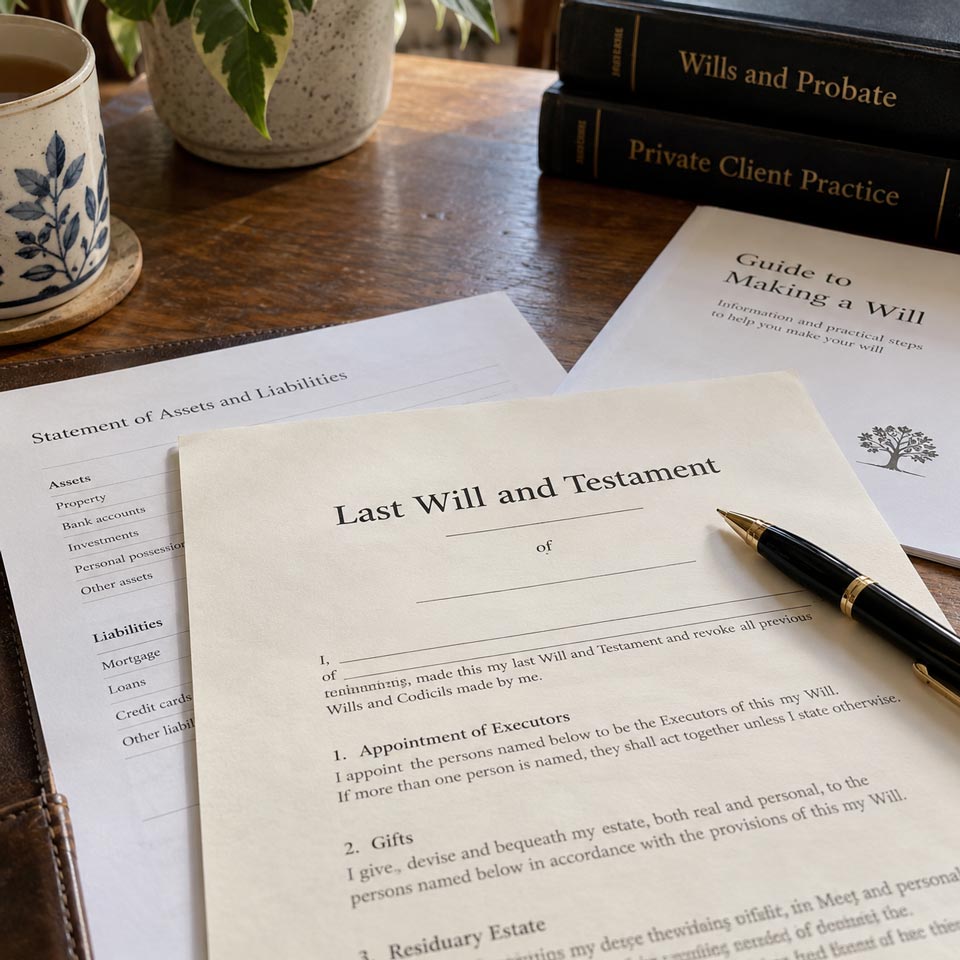
Making a will is one of the most important things you can do to protect your family and ensure your estate is distributed according to your wishes. Unfortunately, even a carefully considered will can become the subject of a disagreement after someone dies.
Inheritance disputes can arise for many reasons. Sometimes, family members believe they have been treated unfairly. In other cases, there are genuine concerns about whether the person making the will understood what they were signing, whether somebody pressured them or whether the document was legally valid.
These disputes can be particularly difficult when families are already dealing with bereavement. They can delay the administration of an estate, create substantial legal expenses and permanently damage relationships between relatives.
So, why are wills contested in the UK, and what can you do to reduce the risk of your own will being challenged?
In this guide, we examine the principal legal grounds for contesting a will, explore statistics from reputable organisations and explain practical steps you can take to protect your estate and your beneficiaries.
Important: This guide reflects the law in England and Wales as of October 2026. Although the article discusses wills in the UK, Scotland and Northern Ireland have different succession laws, and some of the rules explained below do not apply in those jurisdictions.
How Common Are Contested Wills in the UK?
Disagreements about inheritance are certainly not unusual, but it is important to distinguish between someone being unhappy with a will and somebody formally challenging it through the courts.
According to the Ministry of Justice, there were 127 contested probate cases in the High Court in England and Wales during 2025, compared with 125 in 2024. These figures relate to contested probate proceedings handled by the Chancery Division of the High Court. They do not represent every inheritance disagreement, including disputes resolved privately or through mediation. [1]
The consequences of disputes and other problems with probate applications can be significant. Ministry of Justice statistics for April to June 2026 show that probate grants for applications that had been stopped during processing took an average of 14 weeks to issue, compared with approximately two weeks for applications that were not stopped. However, stopped applications can include administrative errors and requests for further information, not just legal disputes. [2]
Other research highlights potential problems long before an estate reaches the probate process.
- 67% of UK adults either had no will or believed their existing will was out of date, according to research published by Will Aid in September 2026. Of those surveyed, 57% had never made a will and a further 10% said their existing will no longer reflected their circumstances or wishes. [3]
- 13% of respondents said they would challenge a will if they considered it unfair, according to a nationally representative survey of 2,000 consumers commissioned by Aviva and published in June 2026. Among respondents aged under 45, the figure was 16%. These results reflect intentions rather than the number of legal challenges actually brought. [4]
- 57% of will holders surveyed had not updated their will within the previous five years, according to research published by Which? in March 2026. The survey involved 1,360 members of the Which? Connect panel, so its findings should not be treated as a population-wide estimate. [5]
These figures demonstrate why careful estate planning matters. An outdated will, poor communication or uncertainty about someone’s intentions can create opportunities for disagreement.
However, there is no comprehensive official dataset that reliably ranks every contested will in the UK by its underlying legal ground. The reasons explored below are therefore established grounds and recurring causes of disputes, rather than a statistical ranking from most to least frequent.
What Are the Most Common Reasons Why Wills Are Contested?
Under the law of England and Wales, a person generally has considerable freedom to decide who inherits their estate. This is known as testamentary freedom.
Importantly, that freedom does not mean a will is immune from legal challenge. A will may be invalid if certain legal requirements have not been satisfied. Separately, some people may be entitled to seek financial provision from an estate even where the will itself is valid.
The following issues are among the principal reasons why wills become disputed.
1. The Person Making the Will Lacked Mental Capacity
One of the most significant grounds for challenging a will is an allegation that the person making it did not have sufficient mental capacity at the relevant time.
This is known as testamentary capacity.
For example, imagine an elderly parent who has developed dementia and makes substantial changes to their will shortly before their death. The new document leaves most of their estate to one relative, despite previous wills distributing everything equally between their children.
Other family members might question whether the parent genuinely understood the changes they were making.
However, having dementia, memory difficulties or another medical condition does not automatically mean someone lacks the capacity to make a valid will.
In England and Wales, the established legal test comes from Banks v Goodfellow (1870). Broadly, the person making the will must be capable of understanding that they are making a will and its consequences, appreciating the nature and extent of their estate, and recognising the potential claims of people who might reasonably expect to benefit. A disorder of the mind must not improperly influence the decisions being made. [7]
The courts consider the person’s capacity at the relevant time, rather than relying solely on a general diagnosis. Medical records, witness evidence, the circumstances surrounding the will and the drafting solicitor’s notes may all become important.
Potential outcome: If the court determines that the person lacked testamentary capacity, the disputed will may be declared invalid. An earlier valid will might then govern the estate. If there is no applicable valid will, the statutory rules of intestacy may apply.
2. Undue Influence or Pressure from Another Person
A will must represent the genuine intentions of the person making it. If somebody forces or coerces them into making particular decisions, the will may be challenged on the grounds of undue influence.
This can become an issue where an individual is elderly, dependent on somebody for care, socially isolated or otherwise vulnerable.
For example, a person might rely on an adult child for shopping, transport and everyday assistance. That child repeatedly threatens to withdraw their support unless the parent changes their will to leave them the family home.
If the threats overcome the parent’s free will and cause them to make a will they would not otherwise have made, there may be grounds for a legal challenge.
However, there is an important distinction between persuasion and coercion.
Someone asking a relative to consider leaving them money does not automatically amount to undue influence. Nor does receiving a larger inheritance than another family member.
Undue influence in probate cases generally requires evidence of coercion that overpowered the person’s own wishes. It can be difficult to prove, particularly where conversations took place privately.
Potential outcome: A successful undue influence claim can result in the affected will, or potentially the relevant provisions, being set aside. Where the evidence does not establish coercion, the challenge may fail and the will may remain effective.
3. Someone Believes They Have Not Received Reasonable Financial Provision
Being excluded from a will does not automatically give somebody the right to receive an inheritance.
Nevertheless, the Inheritance (Provision for Family and Dependants) Act 1975 allows certain people to apply to the court if an estate does not make reasonable financial provision for them.
Those who may qualify include spouses and civil partners, certain former spouses or civil partners, children, people treated as children of the family, qualifying cohabiting partners and people who were financially maintained by the deceased. Each category has specific legal requirements. [8]
For example, someone might leave their entire estate to their adult children from a previous relationship, without making adequate financial provision for their surviving spouse.
The surviving spouse could potentially apply to the court for financial provision, depending on the circumstances.
Another scenario might involve an adult child with significant financial needs who received nothing under a parent’s will. Adult children can bring claims under the legislation, but being someone’s child does not automatically entitle them to an award.
The court considers numerous factors, including the applicant’s financial circumstances, the needs of other beneficiaries, the size of the estate, relevant obligations and responsibilities, and any other relevant circumstances.
Different standards of reasonable financial provision apply to spouses and civil partners compared with other applicants.
Potential outcome: The court may order financial provision, potentially through a lump sum, regular payments or property-related arrangements. Alternatively, it may reject the application if the legal requirements are not satisfied.
Crucially, a successful claim under the 1975 Act does not necessarily invalidate the will. It may instead alter how the estate is distributed.
4. The Will Was Not Signed or Witnessed Correctly
Even where someone’s wishes are perfectly clear, failing to comply with the legal formalities can cause serious problems.
Section 9 of the Wills Act 1837 establishes the requirements for executing a valid will in England and Wales. These include the will being in writing, the required signature and the involvement of two witnesses in accordance with the legislation. [6]
Problems may arise when someone prepares a will themselves, signs it without appropriate witnesses or asks witnesses to sign in circumstances that do not meet the legal requirements.
For example, someone might sign their will at home and subsequently take it to two neighbours, asking them to add their signatures without acknowledging their own signature in the neighbours’ simultaneous presence.
Depending on exactly what happened, this could mean the will was not properly executed.
Another potential problem occurs when a beneficiary witnesses a will.
Under section 15 of the Wills Act 1837, gifts to a witness or their spouse or civil partner are generally void, although this does not necessarily invalidate the remainder of the will. [15]
Potential outcome: A will that fails the statutory execution requirements may be invalid. In other situations, the will may remain valid while a particular gift fails.
5. The Person Did Not Know or Approve the Contents of Their Will
A person must understand and approve the contents of the will they are making.
This issue is particularly relevant where another individual has been heavily involved in preparing the document or where the person signing it has difficulty reading or understanding what it says.
Imagine someone who speaks limited English being presented with a lengthy will by a relative. The relative explains that it simply divides the estate equally between the children, but the document actually leaves most of the estate to that relative.
Following the person’s death, other beneficiaries may question whether they genuinely knew and approved the document’s contents.
Similar concerns can arise where a beneficiary arranged the will, gave instructions on behalf of the person making it or controlled communications with the solicitor.
The court will examine the evidence, including whether the document was explained properly and whether any suspicious circumstances have been satisfactorily addressed.
Potential outcome: If the court is not satisfied that the deceased knew and approved the contents of the will, it may refuse to recognise the document as valid.
6. Fraud, Forgery or Dishonest Allegations
Fraud is another recognised basis for challenging a will.
This might involve somebody forging a signature, substituting pages, deliberately misrepresenting the contents of a document or creating a fraudulent will.
There is also a legal concept known as fraudulent calumny.
This can arise where somebody deliberately makes false allegations about a potential beneficiary, intending to influence the person making the will into excluding or reducing that beneficiary’s inheritance.
For example, a relative might knowingly invent allegations that another family member has stolen money, hoping to persuade their parent to remove that person from the will.
However, proving fraudulent calumny involves more than demonstrating that somebody made an inaccurate statement. The necessary dishonesty, intention and influence on the testamentary decision must be established.
Potential outcome: Fraudulent documents or provisions affected by proven dishonesty may be set aside. Allegations of forgery or fraud can also raise separate criminal law issues.
7. Unclear Wording, Mistakes or Contradictions in the Will
Not every disputed will involves dishonesty or concerns about mental capacity.
Sometimes, the problem is simply that the document has been drafted incorrectly or its wording is unclear.
For example, a person might leave “my house” to one child without clearly identifying which property they mean, despite owning two houses.
Another will might contain contradictory clauses, omit an important beneficiary or fail to explain what happens when a named beneficiary dies before the person making the will.
Depending on the circumstances, these problems can create uncertainty about how the estate should be distributed.
Sections 20 and 21 of the Administration of Justice Act 1982 provide important legal mechanisms concerning the rectification and interpretation of wills.
Section 20 can allow a court to rectify a will where a clerical error or a failure to understand the testator’s instructions has caused the wording to misrepresent their intentions. Section 21 allows certain external evidence to be considered when interpreting ambiguous or meaningless provisions. [9]
Potential outcome: The court may clarify the meaning of a disputed provision or rectify the will if the statutory criteria are satisfied. Not every drafting mistake will qualify for rectification.
8. Marriage, Divorce or Changes in Family Circumstances
Family circumstances can change significantly between the date someone makes their will and the date they die.
Marriage, divorce, separation, the birth of children and the death of beneficiaries can all affect how an estate should be planned.
In England and Wales, marriage will generally revoke an earlier will, subject to statutory exceptions, including certain wills made in contemplation of marriage to a particular person.
Divorce normally does not invalidate the entire will. Instead, provisions benefiting or appointing a former spouse are generally treated as though that former spouse had died, unless the will shows a contrary intention. Similar rules apply in relevant circumstances involving civil partnerships. [15]
For example, someone could make a will leaving everything to their children before remarrying. If the marriage revokes that will and no new valid will is made, their estate could be distributed under the intestacy rules instead of according to their original intentions.
Blended families can create additional difficulties, particularly where a person wishes to provide for a second spouse while ultimately leaving certain assets to children from a previous relationship.
Potential outcome: An outdated or revoked will may produce unintended results, and beneficiaries could find themselves involved in a dispute over the estate or an application for financial provision.
9. Missing Wills, Multiple Versions or Disagreements About the Estate
A final source of disputes involves uncertainty over which will should be followed or whether the original document can be located.
For example, someone might have prepared several wills over a period of twenty years. After their death, family members discover different versions stored in different places.
Questions could arise about which document was made most recently, whether an earlier will was properly revoked or whether the latest document was validly executed.
Where an original will cannot be found, it may also be necessary to investigate whether it was lost, accidentally destroyed or deliberately revoked.
Other disagreements may relate to the administration of the estate rather than the will’s validity, such as disputes about property valuations, the sale of assets or the conduct of executors.
These issues are legally distinct, although they can occur alongside a contested will.
Potential outcome: The court may need to determine which testamentary document governs the estate. Alternatively, an estate administration dispute might be resolved without invalidating the will.
What Happens When Somebody Contests a Will?
The outcome of a contested will depends on the nature of the challenge, the available evidence and the individual circumstances.
Not every dispute results in court proceedings. Some disagreements can be resolved through negotiation or mediation, potentially avoiding the expense and uncertainty of a trial.
Scenario 1: A New Will Is Declared Invalid
Suppose a father makes a new will shortly before his death, leaving his entire estate to one child. His other children challenge the document because they believe he lacked testamentary capacity.
If the court finds that the new will was invalid, an earlier valid will might become operative. If no valid will applies, the estate may instead pass under intestacy rules.
However, the excluded children would not necessarily inherit equally simply because they successfully challenged the later document. The result depends on the earlier valid testamentary arrangements or the applicable intestacy rules.
Scenario 2: The Will Remains Valid, but Financial Provision Is Awarded
Consider a married individual who leaves the majority of their estate to children from an earlier relationship but makes insufficient provision for their surviving spouse.
The spouse could potentially pursue an application under the Inheritance (Provision for Family and Dependants) Act 1975.
If the court determines that reasonable financial provision has not been made, it may order an award from the estate.
The will could remain valid, but the amount ultimately received by other beneficiaries may be reduced.
Scenario 3: The Family Reaches an Agreement
Two siblings disagree about the intended distribution of their parent’s estate because a clause in the will is ambiguous.
Rather than proceeding to a full court hearing, the parties obtain legal advice and negotiate a settlement.
They might reach an agreement on an appropriate distribution, subject to any necessary legal formalities, tax considerations and the rights of other interested parties.
This approach can reduce conflict and legal costs, although not every dispute is suitable for mediation and a settlement is not always possible.
Scenario 4: The Legal Challenge Is Unsuccessful
A daughter believes she should have received a larger inheritance than her brother and alleges that her mother was pressured into making an unequal will.
However, contemporaneous solicitor records demonstrate that the mother gave instructions independently, understood the consequences and consistently expressed the same wishes.
Without sufficient evidence of coercion or another valid legal ground, the daughter may be unable to establish her challenge.
In such circumstances, the will may be upheld. Unsuccessful litigation can also result in significant legal costs, with the court determining costs according to the circumstances.
How Can You Protect Your Will Against Being Contested?
Although no will can be made completely immune from a legal challenge, careful planning can substantially reduce avoidable problems.
The most effective approach is to ensure that your wishes are legally documented, clearly expressed and supported by appropriate evidence.
1. Have Your Will Professionally Prepared by a Solicitor
One of the strongest precautions is to instruct a qualified solicitor who understands wills, probate and estate planning.
A solicitor can help establish what you want to achieve, identify potential legal difficulties and ensure the document accurately reflects your intentions.
They can also explain matters that are easily overlooked, including inheritance rights, the effects of marriage or divorce, the treatment of jointly owned property and the potential consequences of excluding particular family members.
The Solicitors Regulation Authority identifies several areas requiring care when wills are drafted, including testamentary capacity, undue influence, accurate recording of assets and family circumstances, and documenting reasons for excluding potential beneficiaries. [11]
At ASL Solicitors, we provide wills and probate services to clients in Rochdale and across Greater Manchester. We can help you prepare or review your will and consider wider estate planning arrangements to ensure your wishes are properly documented.
2. Ensure Your Will Is Signed and Witnessed Correctly
It is essential that your will is properly executed.
For a standard will made in England and Wales, the requirements include:
- The will must be in writing and signed by you, or by another person acting in your presence and at your direction, with the intention of giving effect to the will.
- Your signature must be made or acknowledged in the presence of two witnesses who are present at the same time.
- Each witness must sign or acknowledge their signature in your presence. Witnesses should be independent adults who are not beneficiaries or the spouse or civil partner of a beneficiary.
- The witnessing process must comply with the applicable legal requirements. For wills made in October 2026, the earlier temporary video-witnessing provisions are no longer available.
The precise statutory requirements are set out in section 9 of the Wills Act 1837. [6]
A solicitor can supervise the execution process and reduce the likelihood of problems arising from incorrect signing or witnessing.
3. Consider a Medical Capacity Assessment Where Appropriate
If there is a realistic possibility that somebody could later question your mental capacity, obtaining appropriate medical evidence can be particularly valuable.
This may be relevant if you are elderly, have experienced a serious illness or have a medical condition that could affect your decision-making ability.
There is a longstanding legal practice principle often described as the Golden Rule. It encourages particular care when wills are prepared for older or seriously ill people, including consideration of a medical practitioner’s assessment of testamentary capacity.
This is guidance rather than an absolute legal requirement. A medical assessment is not mandatory in every case and does not guarantee that a will cannot be challenged. [7]
However, a carefully obtained assessment, alongside detailed contemporaneous solicitor records, may provide important evidence if capacity is later questioned.
It is especially important that the assessment relates to the person’s understanding at the relevant time.
4. Give Your Instructions Independently
If your will is being prepared through a solicitor, you should communicate your wishes directly wherever possible.
This is particularly important when a family member, carer or potential beneficiary is closely involved in your everyday affairs.
Even where somebody is helping you arrange an appointment or organise paperwork, it may be advisable for your solicitor to discuss your instructions with you privately.
This allows the solicitor to establish that the decisions are genuinely yours and that you are not acting because of threats, pressure or coercion.
If you are leaving a substantial part of your estate to somebody who has been caring for you, independent advice and careful documentation can be particularly important.
5. Clearly Explain Your Decisions, Especially When Excluding Family Members
You are not generally required to divide your estate equally between your children under the law of England and Wales.
You might have legitimate reasons for leaving different amounts to different beneficiaries.
For example, you may have provided substantial financial assistance to one child during your lifetime, while another child has received comparatively little support.
Alternatively, you may wish to recognise a family member who has undertaken significant caring responsibilities.
It may be helpful to record your reasons in a separate letter of wishes or through your solicitor’s attendance notes.
Such a record could provide valuable context if your decisions are questioned after your death.
However, a letter of wishes does not prevent somebody from bringing a claim, nor can it automatically defeat a legitimate application under the Inheritance (Provision for Family and Dependants) Act 1975.
A solicitor can advise on how best to document sensitive decisions without inadvertently creating additional problems.
6. Consider Financial Dependants and Potential Inheritance Claims
Before finalising your will, consider whether anybody relies on you financially or may otherwise qualify to bring a claim against your estate.
Particular attention may be necessary if you have a spouse, a civil partner, a long-term cohabiting partner, financially dependent relatives or children with significant financial needs.
For instance, somebody in a second marriage may want to leave their home to children from their first marriage while ensuring their current spouse has somewhere to live.
Simply leaving the entire property to the children without considering the spouse’s circumstances could create difficulties.
Depending on your circumstances, a solicitor might recommend appropriate trust arrangements or other forms of estate planning.
Trusts are not suitable for everybody and do not automatically prevent inheritance disputes. They can also have important legal and tax consequences.
At ASL Solicitors, our wills, trusts and estate planning services can help you explore suitable arrangements for your family and long-term wishes.
7. Use Clear Wording and Identify Your Beneficiaries Properly
A well-drafted will should leave as little uncertainty as reasonably possible.
Beneficiaries should be identifiable, gifts should be clearly described and the will should explain what happens if a beneficiary dies before you.
For example, rather than referring vaguely to “my savings”, it may be more appropriate to establish precisely which assets you intend a particular gift to cover.
The will should also contain an appropriate residuary clause dealing with the remainder of your estate after specific gifts, liabilities and administration expenses have been addressed.
Without an effective residuary provision, some assets may be left undisposed of by the will, potentially resulting in partial intestacy.
Your solicitor can also help you deal with alternative beneficiaries and changes in family circumstances so that the document remains workable if events do not unfold as expected.
8. Appoint Suitable Executors and Trustees
Executors are responsible for administering your estate after your death.
Their duties may involve gathering information about assets and liabilities, applying for probate where required, paying debts and taxes, and distributing the estate in accordance with the will and applicable law.
Choosing suitable executors is therefore an important part of estate planning.
It may be sensible to consider whether your chosen executors are organised, trustworthy, willing to undertake the responsibility and capable of dealing with potentially sensitive family circumstances.
Where relationships are particularly strained, appointing an independent professional executor may be worth considering.
It is also prudent to name appropriate replacement executors in case your first choice is unwilling or unable to act.
9. Review Your Will Regularly
A will should not necessarily be treated as a document that is written once and forgotten.
Government guidance recommends reviewing your will every five years and after significant life events. [10]
Changes that should prompt a review include getting married, separating or divorcing, having children or grandchildren, buying or selling property, receiving an inheritance, experiencing the death of a beneficiary or executor, or making major changes to your finances.
You should also consider reviewing your will if your relationships with family members have changed substantially.
It is important not to make handwritten alterations to an existing executed will without legal advice.
Depending on the changes required, a solicitor may recommend preparing a codicil or making a completely new will that properly revokes earlier testamentary documents.
10. Keep Your Original Will Somewhere Safe and Accessible
A correctly drafted will is of limited practical use if nobody can locate the original after your death.
Missing documents can create uncertainty, delays and potential legal disputes.
Which? reported in March 2026 that 39% of respondents with a will kept it at home, while 49% stored it with a solicitor. The research also found that 9% of respondents with a will had not told their executor where it was kept. [5]
Consider arranging secure storage with your solicitor or another suitable professional service.
You should ensure your executors know where the original document is located and whom to contact when the time comes.
Registration of a will’s location with an appropriate register may also help it to be traced, although registration does not replace the need to preserve the original document.
Avoid marking, removing staples from or otherwise altering an executed original will unnecessarily, as unexplained physical changes can generate questions during probate.
11. Make Sure Your Will Fits Your Wider Estate Planning
Not every asset necessarily passes under the terms of a will.
For example, a property owned as beneficial joint tenants will generally pass automatically to the surviving joint owner, rather than under the deceased person’s will.
By contrast, a deceased person’s share of a property owned as tenants in common can ordinarily form part of their estate and be dealt with under their will.
Pension arrangements, life insurance policies, trusts and business interests may also require separate consideration, depending on their terms and ownership structures.
It is therefore important to understand exactly what assets your will can control.
Reviewing beneficiary nominations, pension arrangements, property ownership and existing trusts alongside your will can help avoid unintended outcomes.
This is especially important where you own a business, have substantial assets or wish to provide for a blended family.
12. Communicate Your Wishes Where Appropriate
Some inheritance disputes are made worse because beneficiaries had completely different expectations about what they would receive.
You are not obliged to disclose the contents of your will to your family during your lifetime.
However, where appropriate and safe, discussing your intentions may help manage expectations and reduce the risk of misunderstandings.
For example, explaining that you intend to leave different amounts to your children because of previous financial support could prevent surprise and resentment after your death.
Nevertheless, communication should be approached carefully. Where there are difficult relationships or concerns about pressure, it may be more appropriate to document your reasoning privately with your solicitor.
The objective is not to persuade everybody to agree with your decisions. It is to ensure that your wishes are clear, voluntary and properly protected.
Can You Make a Will That Cannot Be Contested?
No. There is no standard legal wording or clause that can guarantee a will will never be challenged.
People sometimes ask whether a clause threatening to disinherit anyone who contests a will can completely prevent disputes.
Such clauses require careful specialist advice. Their effectiveness depends on their wording and circumstances, and they cannot simply remove statutory rights or prevent the court from considering legitimate legal challenges.
Similarly, preparing a professionally drafted will does not make it impossible for somebody to pursue proceedings.
What good estate planning can do is reduce uncertainty, improve the available evidence and make avoidable challenges less likely to succeed.
A properly executed will, clear instructions, independent legal advice and contemporaneous records can all strengthen the evidence that the document reflects your genuine intentions.
How Long Does Someone Have to Contest a Will?
There is no single deadline that applies to every type of will dispute in England and Wales.
For example, an application under the Inheritance (Provision for Family and Dependants) Act 1975 is generally subject to a six-month period beginning with the first grant of representation, although the court can permit a late application.
An application to rectify a will under section 20 of the Administration of Justice Act 1982 is also generally subject to a six-month period from the first grant of representation, unless the court grants permission for an application outside that period.
Challenges to the validity of a will involve different considerations. Although there is no equivalent universal six-month statutory deadline for every validity challenge, delay can create serious practical and legal difficulties.
Where there is a genuine dispute about whether a will exists, whether it is valid or who is entitled to apply for probate, it may be appropriate to consider entering a probate caveat.
A caveat initially lasts six months and can prevent a grant from being issued while relevant concerns are investigated. However, caveats should not be used indiscriminately, and they are not generally the appropriate mechanism simply to pursue a financial provision claim. Improper use can create legal costs and other consequences. [13]
Anybody considering contesting a will should obtain specialist legal advice promptly to understand the applicable procedure and any relevant deadlines.
Protect Your Wishes with ASL Solicitors
Writing a will is about more than deciding who receives your money, property and possessions. It is also about giving your loved ones clarity and ensuring that important decisions are made according to your wishes.
While it may be tempting to use a basic template or prepare your own will, errors can have expensive and sometimes irreversible consequences.
At ASL Solicitors, we understand the importance of protecting your estate and planning carefully for the future.
Based in Rochdale, we provide professional wills and probate services to individuals and families throughout Greater Manchester.
Our services include will writing, reviewing and updating existing wills, estate planning, trusts, administration of estates and related legal arrangements.
We can discuss your personal circumstances, explain the available options and help ensure that your will is legally valid and accurately reflects your wishes.
Whether you are preparing your first will, dealing with changing family circumstances or looking to protect a substantial estate, seeking professional legal advice is one of the most important steps you can take.
Find out more about our wills and probate services or contact us today to discuss your requirements.
Frequently Asked Questions About Contested Wills
Can a family member contest a will simply because they have been left out?
Being excluded from a will is not, by itself, sufficient to make the document invalid. However, a family member may have grounds for a challenge if there is evidence of a legal problem, such as a lack of testamentary capacity or undue influence. Certain eligible individuals may also be able to seek reasonable financial provision under the Inheritance (Provision for Family and Dependants) Act 1975.
Can an adult child contest their parent’s will?
Yes. An adult child may challenge a will on recognised legal grounds or potentially apply for financial provision under the 1975 Act. However, adult children are not automatically entitled to a particular share of their parent’s estate in England and Wales. The outcome depends on the legal basis of the claim and the individual circumstances.
Can a will be contested if it was prepared by a solicitor?
Yes. A professionally drafted will can still be challenged if there are legitimate concerns about validity or financial provision. However, a solicitor can help reduce the risk of disputes by ensuring the will is properly drafted and executed, assessing capacity where appropriate and recording the person’s instructions.
Does dementia automatically make a will invalid?
No. A diagnosis of dementia does not automatically mean somebody lacks testamentary capacity. The relevant question is whether they had sufficient capacity to make the will at the time. Appropriate medical evidence and contemporaneous solicitor records may help establish their understanding.
Can a will be contested after probate has been granted?
Yes, some legal challenges may still be possible after probate has been granted. However, different claims have different procedural rules and time limits. For example, financial provision applications under the 1975 Act are generally subject to a six-month deadline from the first grant of representation, unless the court permits a later claim.
Does making a new will automatically cancel an old one?
A properly drafted and validly executed new will will commonly contain a clause expressly revoking earlier wills and codicils. However, the legal position depends on whether the new document is valid and the nature of the revocation. It is advisable to obtain legal advice when replacing an existing will.
Can somebody contest a will because they believe it is unfair?
They may be unhappy with the distribution, but perceived unfairness alone does not normally invalidate a will in England and Wales. A person generally needs to establish a recognised legal ground or qualify for a financial provision claim under the 1975 Act.
What is the best way to stop my will being contested?
There is no guaranteed way to prevent somebody from challenging a will. The strongest practical precautions include using a qualified solicitor, ensuring the document is legally executed, recording your instructions independently, obtaining relevant capacity evidence when appropriate and reviewing your will regularly.
How often should I update my will?
Government guidance recommends reviewing your will every five years and following major life events, such as marriage, divorce, having children, buying property or experiencing significant financial changes. A solicitor can advise whether an amendment or an entirely new will is appropriate.
Can a solicitor help protect my estate from inheritance disputes?
Yes. A solicitor can assess potential legal risks, draft clear testamentary provisions, explain the rights of possible claimants and help you plan for complex family circumstances. At ASL Solicitors, we offer wills, probate and estate planning services to clients in Rochdale and across Greater Manchester.
References & Sources
This article was researched using legislation, government publications, professional regulatory guidance and published research. Legal information reflects the position in England and Wales as of October 2026.
1) Ministry of Justice – Family Court Statistics Quarterly: October to December 2025
https://www.gov.uk/government/statistics/family-court-statistics-quarterly-october-to-december-2025/family-court-statistics-quarterly-october-to-december-2025
2) Ministry of Justice – Family Court Statistics Quarterly: April to June 2026
https://www.gov.uk/government/statistics/family-court-statistics-quarterly-april-to-june-2026/family-court-statistics-quarterly-april-to-june-2026
3) Will Aid – Two Thirds of UK Adults Without an Up-to-Date Will (September 2026)
https://www.willaid.org.uk/news/two-thirds-of-uk-adults-without-an-up-to-date-will
4) Aviva – Where Is the Will? Less Than a Third of People Have a Will and Know Where It Is (June 2026)
https://www.aviva.com/newsroom/news-and-research-overview/news-releases/2026/06/less-than-a-third-of-people-have-a-will-and-know-where-it-is/
5) Which? – Failing to Update a Will Among the Most Common Mistakes (March 2026)
https://www.which.co.uk/policy-and-insight/article/failing-to-update-a-will-among-the-most-common-mistakes-that-could-leave-grieving-family-members-facing-headaches-which-finds-ah7tg6c4vWmq
6) UK Legislation – Wills Act 1837, Section 9: Signing and Attestation of Wills
https://www.legislation.gov.uk/ukpga/Will4and1Vict/7/26/section/9
7) The Law Society – Working with Clients Who May Lack Mental Capacity (August 2025)
https://www.lawsociety.org.uk/topics/client-care/working-with-clients-who-may-lack-mental-capacity
8) UK Legislation – Inheritance (Provision for Family and Dependants) Act 1975
https://www.legislation.gov.uk/ukpga/1975/63
9) UK Legislation – Administration of Justice Act 1982, Sections 20 and 21
https://www.legislation.gov.uk/ukpga/1982/53
10) GOV.UK – Making a Will: Update Your Will
https://www.gov.uk/make-will/updating-your-will
11) Solicitors Regulation Authority – Drafting and Preparation of Wills
https://www.sra.org.uk/solicitors/guidance/drafting-preparation-wills/
12) The Gazette – What Are the Grounds for Contesting a Will?
https://www.thegazette.co.uk/all-notices/content/100023
13) GOV.UK – Stopping a Probate Application: Challenge Someone Else’s Probate Application
https://www.gov.uk/stop-probate-application
14) Law Commission – Recommendations to Modernise Wills Law to Promote Testamentary Freedom (May 2025)
https://lawcom.gov.uk/news/recommendations-to-modernise-wills-law-to-promote-testamentary-freedom/
15) UK Legislation – Wills Act 1837: Witnesses, Marriage and Divorce Provisions
https://www.legislation.gov.uk/ukpga/Will4and1Vict/7/26