
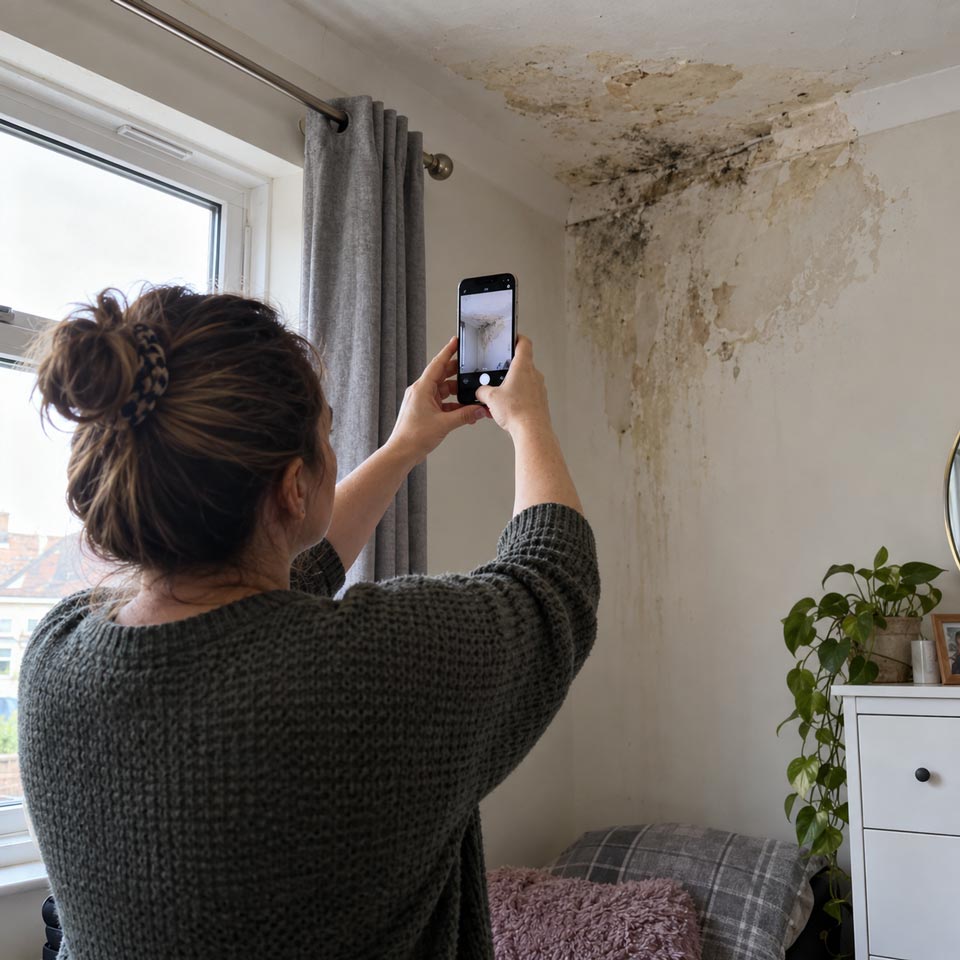
If you live in a council house or housing association property and your landlord has failed to carry out necessary repairs, you may be entitled to compensation. However, having a problem with your home does not automatically mean you have a successful housing disrepair claim. You will usually need evidence showing what went wrong, what your landlord knew, how they responded and how the conditions affected you.
The good news is that gathering evidence does not need to be complicated. Photographs, emails, repair reference numbers and even a simple diary can help establish what happened. You may already have useful evidence without realising it.
In this guide, we explain what evidence you need for a housing disrepair claim, which documents can make the biggest difference to your chances of securing compensation, and how to start gathering evidence if you have not kept any records so far.
At ASL Solicitors, we specialise in housing disrepair claims against councils, local authorities and housing associations. We can review the circumstances of your case, identify any missing evidence and provide a realistic assessment of whether a claim is worth pursuing.
What Counts as Housing Disrepair?
Housing disrepair generally refers to defects or poor conditions in a rented property that the landlord has a legal or contractual responsibility to address. These problems can make a property uncomfortable, difficult to use or potentially unsafe.
Examples of housing disrepair include:
- Damp and mould: Persistent damp, mould growth, water penetration and moisture problems caused by defects in the building.
- Roof and ceiling damage: Leaking roofs, damaged roof coverings, water-stained ceilings and deteriorating plaster.
- Heating and hot water failures: Broken boilers, faulty radiators, unreliable central heating and a lack of hot water.
- Plumbing problems: Leaking pipes, defective drainage, overflowing sanitary fittings and recurring water leaks.
- Electrical defects: Unsafe wiring, damaged electrical installations, faulty sockets and other electrical safety concerns.
- Structural problems: Significant cracks, unstable building elements, deteriorating brickwork and damaged floors or stairs.
- Window and door defects: Broken windows, rotten frames, defective external doors and problems allowing water to enter the property.
- Inadequate ventilation: Defective extraction systems or ventilation problems that contribute to unsafe or unhealthy living conditions.
- Communal area defects: Problems with shared staircases, entrances, lighting or other areas that fall within the landlord’s repairing obligations.
Not every defect will justify a compensation claim. A minor cosmetic problem, an issue that has only just been reported, or damage that the tenant is responsible for may not establish a breach of the landlord’s duties.
The circumstances also matter. A small leak that is repaired promptly may have a very different legal outcome from repeated water ingress that continues for months and leaves a bedroom unusable.
What Evidence Do You Need for a Housing Disrepair Claim?
The strongest housing disrepair claims are generally supported by several different forms of evidence. Rather than relying on one photograph or complaint, it helps to build a clear record showing the condition of the property, the landlord’s knowledge of the problem and the consequences of any failure to act.
Shelter’s guidance identifies photographs, correspondence, receipts, expert reports and medical evidence as potentially useful documents in housing repair proceedings. [1]
1. Photographs and Videos of the Disrepair
Photographs are among the most useful forms of evidence because they show the physical condition of your home. They may help establish the seriousness of the problem, the rooms affected and whether conditions have deteriorated over time.
For example, if you have damp and mould in a bedroom, take photographs showing both the affected wall and the wider room. A close-up image may demonstrate the extent of the mould, while a wider photograph can show its location and how much of the room has been affected.
Try to take photographs on different dates. If a leak repeatedly returns after repairs, photographs taken before and after each repair can help demonstrate that the underlying problem was not resolved.
Videos can be particularly useful when documenting problems that are difficult to demonstrate with photographs. Examples include water dripping through a ceiling, a radiator failing to heat up, or water entering through a damaged window during heavy rainfall.
Our advice: Keep the original photographs and videos wherever possible. Avoid editing them, removing date information or relying entirely on screenshots. Original files may contain useful information about when the images were taken.
You do not need professional photography equipment. Clear photographs taken on an ordinary smartphone can be valuable evidence.
2. Proof That You Reported the Problem to Your Landlord
One of the most important questions in many housing disrepair cases is whether the landlord knew about the problem and had a reasonable opportunity to address it.
Depending on the legal duty involved and the circumstances, a landlord’s obligation to carry out particular repairs will often depend on the landlord having notice of the defect. Notice may come from a tenant’s report, an inspection or another reliable source.
Useful evidence includes emails, letters, text messages, online repair requests, complaint acknowledgements and confirmation messages from the landlord’s repairs system.
If you report a problem by telephone, keep the date and approximate time of the call, the name of the person you spoke to where available, and any repair reference number you receive.
For example, an email reporting a leaking roof in January, followed by further emails in February and March showing that no effective repair had been completed, may be considerably stronger than an unsupported statement that the roof has been leaking for several months.
Why does this matter? In England, the Pre-Action Protocol for Housing Conditions Claims specifically addresses evidence of notification, the history of defects and the landlord’s knowledge of the conditions. [2]
However, you do not necessarily need to have complained repeatedly. A single clear report may provide sufficient notice in an appropriate case. What matters is whether the landlord had the relevant knowledge and failed to meet its legal obligations.
3. Repair Records and Maintenance History
Your landlord’s own records may contain some of the most persuasive evidence available.
Councils and housing associations commonly maintain records of repair requests, appointments, inspections, contractor visits, work orders and completed jobs.
These documents can help establish when the landlord became aware of a defect, what it believed was causing the problem and what action was taken.
For example, suppose a housing association’s records show that a contractor attended to a recurring leak on three occasions but the underlying cause remained unresolved. That history could be important when assessing whether the repairs were effective and whether the landlord acted reasonably.
If you have access to an online tenant portal, save copies or screenshots of the repair history, including completed and cancelled appointments.
Do not be concerned if you cannot access your landlord’s internal records. We can advise you on obtaining relevant documents when investigating a potential claim.
4. Independent Surveyor Reports
An independent inspection can be particularly valuable where the cause of the disrepair is disputed.
A suitably qualified surveyor may be able to identify the defects, explain their likely causes, recommend remedial work and assess the condition of the property.
This can be important in damp and mould cases, where there may be disagreement about whether moisture is caused by a building defect, inadequate ventilation, condensation or a combination of factors.
Photographs can show that mould exists, but a professional inspection may help determine whether the landlord is legally responsible for the underlying problem.
In England, the relevant court protocol provides a framework for expert evidence, including the possible appointment of a single joint expert or a joint inspection by experts representing both sides. [2]
Do you need to pay for a survey yourself? Not necessarily. We recommend obtaining legal advice before commissioning an expensive report purely for litigation purposes. We can assess what evidence is already available and advise whether expert evidence is necessary and how it should be obtained.
5. Medical Records and Evidence of Health Problems
Some housing conditions can affect physical or mental health. Persistent damp and mould, excessive cold, unsafe electrical installations and other hazards may create particular difficulties for vulnerable residents.
If you believe the disrepair has affected your health, medical evidence may be relevant. This might include GP records, hospital correspondence, prescription information and reports from an appropriate medical professional.
For example, someone with a respiratory condition may have medical records documenting worsening symptoms during a period when their home was affected by significant damp and mould.
However, medical records alone do not necessarily prove that housing disrepair caused an illness or injury. Establishing a connection may require further medical evidence, taking account of other possible causes.
If a child, older person or someone with a disability is affected, explain those circumstances when reporting the problem to your landlord. This information can be important when the landlord assesses the seriousness and urgency of a hazard.
Shelter also identifies medical reports and letters as potentially relevant evidence where tenants allege that poor housing conditions have affected their health. [1]
6. Evidence of Damaged Belongings
Housing disrepair can damage furniture, carpets, clothing, electrical appliances and other possessions.
For example, a persistent leak might damage a mattress and wardrobe, while damp conditions could cause mould growth on clothing stored against an affected wall.
Photograph any damaged belongings before disposing of them, provided doing so is safe. Keep purchase receipts, replacement invoices and any documents that help demonstrate the value and condition of the items.
It can also be useful to photograph the damaged possessions in the location where the problem occurred.
Compensation for belongings is not automatic. You will normally need to establish that the loss was caused by the landlord’s actionable breach, demonstrate the value of the loss and account for factors such as the age and condition of the items.
7. Receipts and Evidence of Additional Expenses
You may have incurred additional costs because of unresolved disrepair. These expenses can sometimes form part of a compensation claim where they were reasonable, caused by the breach and supported by evidence.
Examples include increased heating costs, additional laundry expenses, replacement bedding, temporary accommodation costs and other necessary expenditure resulting from the conditions.
Suppose your central heating repeatedly failed during winter and you needed to use portable electric heaters. Electricity bills and records of heater purchases may help establish whether you suffered additional expense.
Similarly, receipts for replacing belongings damaged by a persistent leak may support a claim for financial losses.
Keep invoices and receipts together, and write a short explanation of why each expense was necessary.
8. A Diary Showing How the Disrepair Affected Your Life
One of the most overlooked forms of evidence is a simple written diary.
Compensation is not always limited to damaged possessions or direct financial losses. In appropriate cases, tenants may also recover damages for the inconvenience, discomfort and loss of enjoyment caused by a landlord’s breach of its repairing obligations. [3]
A diary can help explain the practical consequences of the disrepair.
For example, rather than simply stating that a bedroom was affected by damp, record when the problem started, whether furniture needed to be moved, whether the room could still be slept in and how long those restrictions continued.
If a broken boiler left your household without adequate heating, record the dates affected, any temporary heating arrangements and the impact on your daily routine.
Keep entries factual and accurate. If you are unsure about a date, say so rather than presenting an estimate as certain.
9. Witness Statements
Other people may be able to confirm the conditions in your home or how they affected you.
For example, a relative who visited during a prolonged heating failure may be able to describe how cold the property was. A neighbour may have witnessed water entering through a damaged roof, while another household member may be able to describe the impact of persistent mould.
A witness statement should be based on what the person genuinely saw, heard or experienced, rather than assumptions or information provided by someone else.
Not every claim requires witness evidence. However, it may be helpful where important events are disputed or where the physical condition has since changed.
10. Tenancy Agreements and Other Housing Documents
Your tenancy agreement or occupation contract helps establish your relationship with the landlord and may contain terms relating to repairs, access, maintenance and responsibilities.
It is also useful to keep rent statements, relevant correspondence received when you moved in, property inspection reports and any condition reports completed at the start of your tenancy.
These documents can help determine which organisation is responsible for the property and whether specific repairing obligations apply.
If you have lost your agreement, you can ask your landlord for a copy.
Which Evidence Is Most Important for Winning Compensation?
There is no single document that guarantees a successful housing disrepair claim.
Nevertheless, some combinations of evidence are particularly persuasive because they address the central questions involved in establishing liability and calculating compensation.
Evidence That the Landlord Knew About the Problem
Where notification or knowledge is relevant to the legal duty, dated correspondence or repair records can be crucial.
They may establish when the landlord was first informed, how frequently the problem was raised and whether there was sufficient opportunity to carry out an appropriate repair.
Evidence That the Problem Continued
A sequence of dated photographs, reports and repair records may establish that the problem persisted despite the landlord’s involvement.
This is especially useful when a landlord argues that a repair was completed or that the defect was only temporary.
Evidence Establishing the Cause of the Disrepair
Where responsibility is disputed, independent expert evidence can be particularly influential.
A professional assessment identifying defective roofing, failed plumbing or another relevant cause may help establish whether the condition falls within the landlord’s legal obligations.
Evidence Demonstrating the Impact on Your Home and Finances
Medical records, receipts, photographs of damaged possessions and a consistent diary may help demonstrate the consequences of the problem.
For compensation purposes, it is useful to distinguish between the existence of disrepair and the actual losses or inconvenience resulting from an actionable breach.
The strongest cases often have a clear timeline: the defect appeared, the landlord became aware of it, the landlord failed to take appropriate action within the relevant timeframe, and the tenant experienced identifiable consequences.
How to Gather Evidence if You Have Not Started Yet
If you have been living with housing problems for months but have not kept records, you may still have a potential claim.
Evidence gathering can begin at any stage. You should not assume that your case is impossible simply because you did not take photographs when the issue first appeared.
Here is a practical approach to getting organised.
- Report the disrepair immediately. Contact your council or housing association using its repairs reporting procedure. Explain the problem, where it is located, when you first noticed it and whether anyone is at immediate risk. If the problem is dangerous, use the landlord’s emergency repairs service rather than waiting to gather evidence.
- Take clear photographs and videos. Record the condition of each affected area. Include close-up images and wider photographs. Continue taking photographs when conditions change or problems return.
- Save all correspondence. Keep emails, text messages, letters and online repair acknowledgements. Record any repair reference numbers and save screenshots of your landlord’s online portal.
- Create a timeline. Write down when you first noticed the defect, when you reported it, who attended, what work was completed and whether the problem continued. Distinguish confirmed dates from approximate ones.
- Start a daily or weekly diary. Record how the disrepair affects the household, including rooms you cannot use properly, interruptions to heating or water, disrupted sleep and other relevant consequences.
- Keep evidence of financial losses. Save receipts, invoices, photographs of damaged belongings and relevant household bills. Avoid disposing of damaged possessions before recording their condition where possible.
- Request relevant records. Ask your landlord for repair histories, inspection reports and complaint correspondence. You may also be able to obtain personal information held about you through a subject access request.
- Speak to ASL Solicitors. Once you have gathered the available information, or even if some evidence is missing, contact us for an assessment. We can review the circumstances and advise on the next appropriate steps.
Under UK data protection law, a subject access request can help you obtain personal information held by an organisation. The Information Commissioner’s Office explains that organisations normally have one month to respond, although extensions and other qualifications can apply. A subject access request does not necessarily entitle you to every internal document concerning the property. [4]
Example: How a Tenant Could Build an Evidence Timeline
Consider a hypothetical tenant living in a housing association flat where a bedroom wall becomes damp after heavy rainfall.
In January, the tenant reports the damp through the landlord’s online repairs system and receives a reference number.
In February, a contractor attends and treats the affected wall, but the tenant continues noticing water staining after rainfall. The tenant photographs the area and submits a further repair request.
By March, mould has developed behind furniture. The tenant takes additional photographs, records the damage and sends a written complaint explaining that the bedroom is becoming difficult to use.
In April, another inspection identifies a possible defect in the external wall or guttering. The tenant retains the inspection correspondence and takes further photographs showing the condition before repairs are completed.
This creates several potentially useful sources of evidence: repair notifications, photographs taken over time, contractor attendance records, written complaints and information about the effects on the tenant.
Whether a claim would succeed would still depend on the landlord’s actual obligations, the cause and seriousness of the conditions, the reasonableness of its response and the evidence of any resulting loss.
However, the documented history gives a solicitor a much clearer starting point than a general statement that the landlord has ignored the problem.
What Happens to Your Evidence When You Make a Claim?
When you approach ASL Solicitors, we will consider the available evidence alongside the legal obligations of your council or housing association.
We may need to establish when the defect appeared, how the landlord became aware of it, what repairs or inspections took place, and whether the conditions resulted from a breach of the landlord’s duties.
In appropriate cases, we may advise on obtaining further records or arranging an expert assessment.
For properties in England, the Pre-Action Protocol for Housing Conditions Claims provides a framework for exchanging information before court proceedings begin. This includes a letter of claim, disclosure of relevant documents and procedures relating to expert evidence.
The protocol aims to encourage the early resolution of disputes, the completion of necessary repairs and payment of compensation where appropriate, without unnecessary litigation. [2]
Many disputes can be resolved without a final court hearing. Nevertheless, whether settlement is possible depends on the landlord’s response, the evidence and the matters in dispute.
Can You Claim Compensation if the Repairs Have Already Been Completed?
Potentially, yes. The fact that your landlord has now repaired the property does not necessarily prevent a claim concerning an earlier breach of its repairing obligations.
For example, if a roof leak continued for several months despite repeated reports, the tenant may still have experienced inconvenience, loss of use of a room or damage to possessions during the relevant period.
Earlier photographs, repair records and correspondence may be important in demonstrating what happened before the repairs were completed.
However, the landlord’s conduct must still amount to an actionable breach, and any claimed losses must be established.
Legal time limits also apply. In England and Wales, a contractual claim will generally be subject to a six-year limitation period, while personal injury claims usually have a three-year period, subject to important qualifications and exceptions. [15]
Different rules can apply in Scotland and Northern Ireland. If the problem occurred some time ago, seek legal advice promptly rather than assuming that you remain within time.
What if You Have No Photographs or Written Evidence?
Not having photographs or a written repair history does not automatically prevent a housing disrepair claim.
For example, your landlord may have retained records of telephone complaints, contractor visits or previous inspections. These documents could help establish what occurred.
Other potential evidence might include witness accounts, historic medical records, correspondence with housing officers or records of earlier repair appointments.
The important question is whether sufficient reliable evidence can be obtained to establish the necessary elements of the claim.
We can assess what is available and explain whether further evidence would be needed before the case could reasonably proceed.
When Might a Housing Disrepair Claim Be Unsuccessful?
Not every unresolved housing problem results in a valid compensation claim.
A claim may be difficult to pursue if the evidence does not establish that the landlord was responsible for the defect, had the necessary knowledge or failed to comply with an applicable duty.
For example, if a tenant reports a minor repair and the landlord completes it properly within a reasonable period, there may be no actionable failure.
Likewise, where a problem results entirely from damage caused by a tenant and falls outside the landlord’s relevant obligations, a claim may not be available.
Cases can also become more complicated where reasonable access for inspections and repairs has repeatedly been refused, where the cause of a defect is disputed, or where there is insufficient evidence of the alleged losses.
Another consideration is proportionality. Even where a technical breach may have occurred, the evidence, potential compensation, likely costs and appropriate route for resolving the matter all need to be considered.
Every housing disrepair claim is different. The likelihood of success cannot be determined solely by the type of defect or the number of photographs available.
At ASL Solicitors, we believe it is important to give clients a realistic assessment rather than suggesting that compensation is guaranteed. If we do not consider a claim to have reasonable prospects, we will explain our assessment and discuss any appropriate alternatives.
Should You Complain to Your Landlord Before Making a Claim?
You should report disrepair to your landlord as soon as you become aware of it. This gives the landlord an opportunity to investigate and respond, and it creates an important record of the problem.
If the landlord fails to act appropriately, you can use its formal complaints procedure.
In England, social housing residents can generally escalate unresolved complaints to the Housing Ombudsman after completing the landlord’s complaints process, subject to the Ombudsman’s rules.
The Housing Ombudsman can investigate complaints concerning repairs and service failures and may order remedies, including compensation in appropriate cases. This is a separate process from pursuing a civil claim through the courts. [16]
It is important to obtain advice about the most suitable route because complaints, Ombudsman proceedings and court claims can involve different remedies and restrictions.
For serious hazards, do not delay seeking urgent assistance while preparing a formal complaint or legal claim.
Speak to ASL Solicitors About Your Housing Disrepair Claim
If you live in council housing or a housing association property and have been dealing with unresolved disrepair, we can help you understand your legal position.
At ASL Solicitors, we specialise in council housing and housing association disrepair claims. We assess potential claims involving damp and mould, structural defects, water damage, heating problems and other housing conditions.
Our housing disrepair team is based at our head office in Rochdale, and we provide services to eligible social housing tenants across the UK, subject to the applicable legal jurisdiction and the circumstances of the case.
Most initial discussions and consultations can take place remotely by telephone or video call. This means you do not need to travel to Rochdale to discuss a potential claim with us. In-person consultations can also be arranged where appropriate.
We only handle housing disrepair claims against councils, local authorities and housing associations. We do not provide this service for claims against private landlords.
Whether you have collected extensive evidence or are unsure where to begin, we can review your circumstances, identify the information needed and provide a realistic assessment of your options.
Contact ASL Solicitors today to discuss your housing conditions and find out whether you may have grounds to pursue a claim.
Frequently Asked Questions About Housing Disrepair Evidence
What evidence is needed for a housing disrepair claim?
Useful evidence includes photographs, repair requests, emails, inspection reports, tenancy documents and records of how the disrepair affected you. Receipts, medical evidence and witness statements may also help. The evidence needed will depend on the individual circumstances.
Can I make a housing disrepair claim without photographs?
Yes, potentially. Photographs are helpful but are not always essential. Repair records, correspondence, inspection reports and witness evidence may help establish the condition of the property and the landlord’s knowledge of the problem.
How many times do I need to report disrepair before making a claim?
There is no universal minimum number of reports. In many cases, one clear notification may be sufficient to establish that the landlord knew about a defect. Whether the landlord subsequently breached its duties depends on the circumstances, including the seriousness of the problem and the time allowed for repairs.
Do I need a surveyor’s report to claim compensation?
Not every claim requires a surveyor’s report at the outset. Expert evidence may become important where the cause, severity or extent of the disrepair is disputed. A solicitor can advise whether an inspection is necessary and how it should be arranged.
Can I claim if my landlord has already repaired the problem?
Potentially. Repairs being completed does not automatically prevent a claim for an earlier breach. You may still be able to pursue compensation for proven losses or inconvenience caused during the period when the landlord failed to meet its obligations.
Can medical records help my housing disrepair claim?
Yes. Medical records may support allegations that housing conditions affected your health. However, further evidence may be needed to establish a causal connection between the disrepair and the illness or injury claimed.
Can I claim compensation for furniture damaged by damp or leaks?
Potentially. If an actionable breach by the landlord caused damage to your belongings, you may be able to claim the value of your proven loss. Photographs, receipts and replacement invoices can help establish what was damaged and its value.
How far back can I claim for housing disrepair?
Time limits depend on the legal basis of the claim and where the property is located. Contractual claims in England and Wales generally have a six-year limitation period, while personal injury claims usually have a three-year period. Exceptions and different rules may apply, so obtain individual legal advice promptly.
What if my council or housing association says the problem is my fault?
A landlord’s assertion that the tenant caused a defect does not necessarily settle the issue. The cause of the problem, the parties’ responsibilities and the available evidence must be examined. An independent inspection may help where responsibility is disputed.
Can I claim compensation if I have been living with disrepair for years?
Possibly. Long-running disrepair may support a claim if there is evidence that the landlord breached an applicable legal obligation and caused compensable losses. However, limitation periods, evidence of notice and the history of repairs must all be considered.
Do I have to go to court to receive housing disrepair compensation?
Not necessarily. Some claims can be settled through negotiation without a final court hearing. However, settlement is not guaranteed and legal proceedings may sometimes be necessary to resolve disputed issues.
Can ASL Solicitors help if I have not collected any evidence?
Yes. We can discuss the condition of your property, identify what information may be available and explain how you could strengthen the evidence supporting a potential claim. We will also give you an assessment of whether the circumstances justify further investigation.
References and Sources
The legal information in this guide has been prepared with reference to legislation and official guidance applicable as of October 2026. The law differs across UK jurisdictions, and this article provides general information rather than individual legal advice.
1) Shelter England – Get Evidence of Repair Problems:
https://england.shelter.org.uk/housing_advice/repairs/legal_action_if_your_landlord_wont_do_repairs/evidence
2) Ministry of Justice – Pre-Action Protocol for Housing Conditions Claims (England):
https://www.justice.gov.uk/courts/procedure-rules/civil/protocol/prot_hou
3) Shelter England – How to Take Your Landlord to Court for Repairs:
https://england.shelter.org.uk/housing_advice/repairs/legal_action_if_your_landlord_wont_do_repairs
4) Information Commissioner’s Office – What to Expect After Making a Subject Access Request:
https://ico.org.uk/for-the-public/getting-copies-of-your-information-subject-access-request/what-to-expect-after-making-a-subject-access-request
5) UK Legislation – Landlord and Tenant Act 1985:
https://www.legislation.gov.uk/ukpga/1985/70/contents
6) UK Legislation – Homes (Fitness for Human Habitation) Act 2018:
https://www.legislation.gov.uk/ukpga/2018/34/contents
7) UK Legislation – Housing Act 2004:
https://www.legislation.gov.uk/ukpga/2004/34/contents
8) Ministry of Housing, Communities and Local Government – Awaab’s Law in the Social Rented Sector:
https://www.gov.uk/government/collections/awaabs-law-in-the-social-rented-sector
9) Regulator of Social Housing – Safety and Quality Standard:
https://www.gov.uk/government/publications/safety-and-quality-standard
10) UK Legislation – Defective Premises Act 1972:
https://www.legislation.gov.uk/ukpga/1972/35/contents
11) Welsh Government – Fitness for Human Habitation: Guidance for Tenants:
https://www.gov.wales/fitness-human-habitation-guidance-tenants-contract-holders-html
12) Ministry of Justice – Pre-Action Protocol for Housing Disrepair Cases (Wales):
https://www.justice.gov.uk/courts/procedure-rules/civil/protocol/pre-action-protocol-for-housing-disrepair-cases-wales
13) UK Legislation – Housing (Scotland) Act 2001:
https://www.legislation.gov.uk/asp/2001/10/contents
14) NI Direct – Repairs for Housing Executive and Housing Association Tenants:
https://www.nidirect.gov.uk/articles/repairs-housing-executive-and-housing-association-tenants
15) UK Legislation – Limitation Act 1980:
https://www.legislation.gov.uk/ukpga/1980/58/contents
16) GOV.UK – Social Housing Complaints: Make Things Right:
https://www.gov.uk/guidance/social-housing-complaints-make-things-right