Repair duties and the law in Leeds
Section 11 of the Landlord and Tenant Act 1985 generally requires a landlord to keep the structure and exterior of a rented home in repair, together with key installations for water, sanitation, gas, electricity, space heating and hot water. Sections 9A and 10 of the same Act address whether a home is fit for human habitation, including relevant hazards under the Housing Act 2004 framework. The facts, tenancy and responsibility for the defect all matter.
Since 27 October 2025, the first phase of Awaab’s Law has imposed additional deadlines on relevant social landlords for emergency hazards and significant damp and mould. Emergency hazards must be investigated and made safe within 24 hours; significant damp or mould hazards ordinarily require investigation within 10 working days, followed by action to make the home safe within five working days. The next phase, extending to more significant hazards, is scheduled for 30 November 2026 and was not yet in force on 17 November 2026.
How the housing disrepair claim process works
Step 1: Tell us which landlord you rent from
We check your tenancy, address and whether the repair concerns the home, the exterior or a shared part of the block.
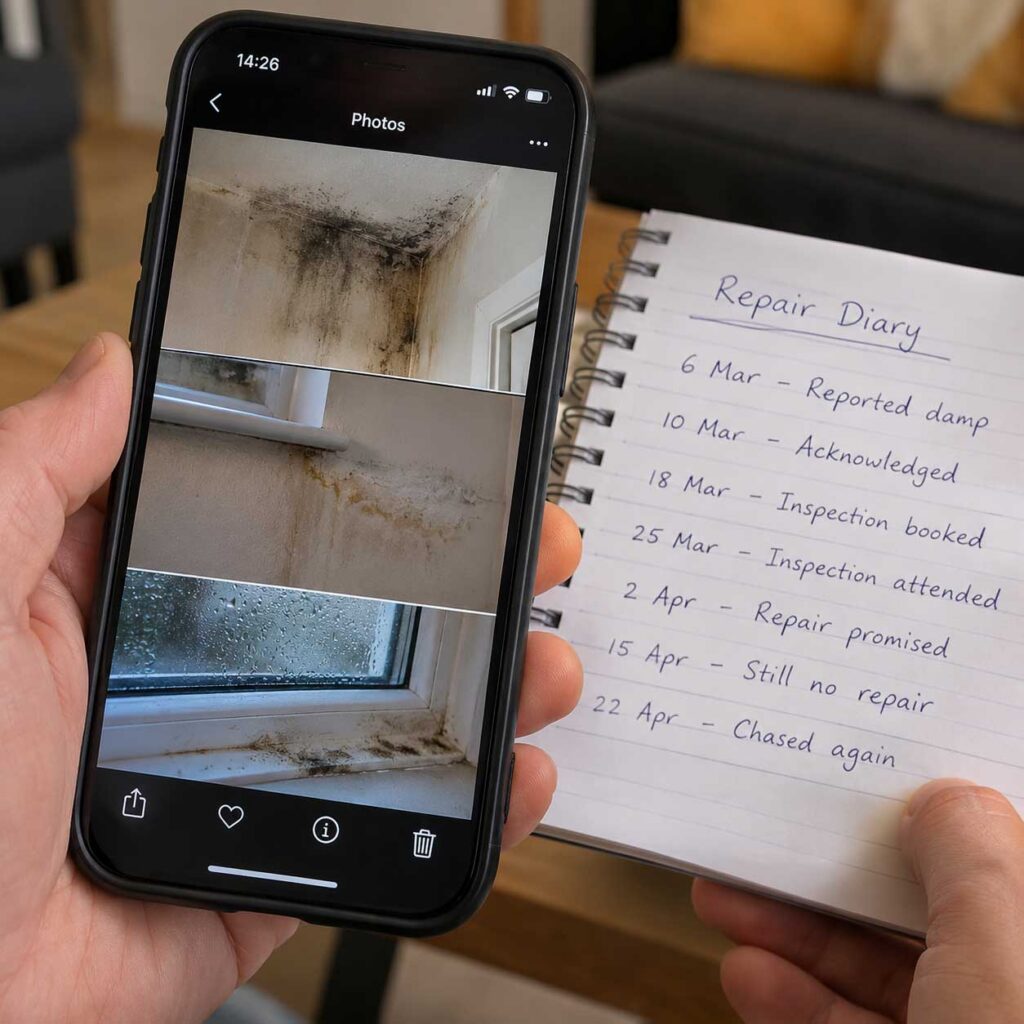
Step 2: Build a clear repair timeline
We ask for reports, acknowledgements, photographs and appointments. You can use our housing disrepair evidence checklist to prepare before speaking to us.
Step 3: Identify the underlying problem
A surveyor or other expert may be appropriate if the cause of a leak, damp or building movement is disputed.
Step 4: Explain the legal case and funding
We discuss the likely strengths, risks, potential remedies and how legal costs would be handled before you decide whether to proceed.
Step 5: Raise the formal claim
Where justified, we follow the applicable Pre-Action Protocol for Housing Conditions Claims, giving the landlord an opportunity to inspect, respond and propose appropriate works.
Step 6: Try to resolve matters without a hearing
We work towards agreement on repairs and any compensation evidenced by the case. Many claims settle through correspondence or negotiation; if agreement is not possible, we explain the court options.